This week, the global cosmetics and personal care industry highlighted the growing convergence of governance changes, AI-driven innovation and retail transformation, as global groups advanced leadership reshuffles, technology partnerships and expansion strategies across multiple markets.
Corporate governance and leadership developments featured prominently. Coty appointed five new independent directors as part of a board refresh. Puig named Jose Manuel Albesa as CEO within a wider governance restructure. Revive Collagen appointed Mel B as global ambassador for its menopause range.
Financial performance and macroeconomic pressures continued to shape outlooks. BASF raised prices amid rising costs linked to the Middle East conflict. handle warned of a slow start to 2026 due to weak consumer sentiment, while also investing US$70 million in a new R&D centre in Connecticut. Waldencast reported flat FY2025 revenue as its portfolio transformation continued. Macy’s returned to comparable sales growth as FY2025 results exceeded expectations. Nature completed its restructuring with strong profit growth in 2025.
Retail, distribution and market expansion remained active globally. APR entered India with its Medicube brand via Nykaa. Cymbiotica partnered with Ulta Beauty for a nationwide retail launch. JD.com expanded into Europe with its Joybuy e-commerce platform. Yassir acquired Uno retail chain to expand its hybrid retail and e-commerce network.
Technology, AI and digital commerce developments continued to accelerate. L’Oreal expanded its partnership with NVIDIA to advance AI-driven beauty innovation. Amorepacific launched its AI-powered ‘Amore Mall’ shopping app on ChatGPT. Ulta Beauty expanded its digital strategy through a TikTok Shop launch.
M&A, investment and partnership activity also featured. L Catterton targeted ¥50 billion in Japanese consumer investments. BRITA invested in Hello Klean to expand into shower filtration within beauty. Iconix partnered with A dream to launch the first SALT LIFE fragrance.
Legal, regulatory and industry oversight developments remained in focus.India opened an investigation into fragrance companies over alleged anti-poaching agreements. Nigeria introduced its first national policy on cosmetics safety.
Category convergence between health, wellness and beauty continued to develop. Symrise launched a Care & Wellness division to integrate health and beauty solutions. In the US, the wellness boom contributed to a shift from traditional retail stores toward service-based leasing models. Thailand advanced initiatives to promote wellness tourism to attract higher-value visitors.
Financing and restructuring activity remained ongoing.Saks Finel accesses final US$300 million pre-emergence funding tranche.
Taken together, this week reflected continued activity across governance changes, AI integration and retail expansion, alongside ongoing investment, regulatory developments and evolving consumer models linking wellness, commerce and technology.
*Links marked with asterisks are affiliate links, these help Ree with running costs of the blog
Priced at
If you’re in the mood for something soft, effortless and a little bit different, DedCool Mineral Milk Eau de Parfum is a breath of fresh, salty air. It’s creamy, airy and pretty addictive. One of those “your skin but better” scents that you want to keep sniffing!
This is a fragrance that leans into comfort and nostalgia, but with a modern, coastal twist. Think sun-warmed skin, sea breeze and a subtle, milky warmth that never feels heavy. Here’s what you need to know.
What Does DedCool Mineral Milk Smell Like?
DedCool Mineral Milk Eau de Parfum
When I first spray this, I get a lovely light and airy freshness with the softest hint of lavender, which feels modern yet super familiar.
Very quickly, it melts into something creamier, more skin-like and subtly sexy. The amber milk note gives it that buttery warmth, while the marine salt adds a breezy, beachy edge that keeps it from ever feeling too sweet or dense.
What I really love is the subtle saltiness running through it. It gives the fragrance that effortless, easy, beachy feel without going tropical or overly summery. It genuinely reminds me of warm skin after a day by the sea.
As it dries down, a delicate floral note comes through and interestingly, I also get something that feels a bit like coconut, even though it’s not listed. I think it’s just that creamy, sun-warmed effect that gives it that impression.
DedCool Mineral Milk Eau de Parfum Notes
Top Notes: Golden nectar and passionfruit.
Heart Notes: Coastal lavender, ocean air and marine salt.
Base Notes: Amber milk, Virginia cedar and Australian sandalwood.
DedCool Mineral Milk Eau de Parfum Review
DedCool Mineral Milk Eau de Parfum
I literally just met this new launch from DedCool, but I have to say, it was love at first sniff. I tried it at the Space NK fragrance pop up along with quite a few other fragrances, and it’s the one I keep thinking about. I also loved the newness from Glossier You, Ellis Brooklyn, and Escentric Moleculeand will share more info on those in due course.
How It Wears
This is very much a skin scent, much like another of my favourites, the DedCool Xtra Milk Eau de Parfum, however, I think this one does actually pack a bit more of a punch, which I love.
It does still sit pretty close to the skin, but I find it fairly long lasting. It won’t fill a room, but it will have you constantly smelling your wrists (which, honestly, is half the joy of this kind of fragrance).
My Thoughts
I really love this. It’s such a gorgeous creamy, salty, airy composition that feels fresh but still comforting and a little bit sexy. It’s soft and understated, but still has enough character to feel interesting. The combination of that creamy milkiness with the hint of salt is what makes it for me. It just melts into the skin in such a natural, flattering way.
Who Is It For?
Anyone who loves skin scents
If you enjoy salty, beachy fragrances without heavy coconut
Those looking for a light, summery perfume
Perfect for layering with other fragrances
Ideal if you want something subtle and office-appropriate
It’s also designed to be genderless, so will work on anyone.
Final Verdict
DedCool Mineral Milk is a really beautiful, easy fragrance that feels modern and comforting at the same time.
On me, it’s all about creamy, slightly salty skin with a soft floral touch, and I find it incredibly addictive in a very understated way. If you like fragrances that don’t shout but still feel special, this is definitely one to try.
Where to buy it
DedCool Mineral Milk is available now at Space NK.
Why I Left Emergency Medicine to Start a Natural Skincare Company
When life presents you with the opportunity to hear your mother’s last heartbeat, with your ear desperately pressed against her chest while your 3-month-old baby is crying in the next room, time has a way of collapsing and expanding all at once. Or did it implode? I’m not sure, but it made me think long and hard about my life, how it might go faster than I had planned, and what I wanted to do with the time I have here on Planet Earth.
I’m a doctor. Countless sleepless nights and a degree from Georgetown University will prove it. I trained as an emergency physician in Washington DC, where I saw everything from stab wounds to anxiety attacks to babies born in the ambulance bay to foreign objects inserted in places beyond your wildest imagination. I had the best work stories at any dinner party—unless it was with my medical friends, and then it was a contest to see who had seen the most surreal or ridiculous or life-affirming cases that week. I finished my training and moved to Colorado with my husband and our then 2-year-old daughter. Until that point, I had lived within 10 miles of my parents for my entire life.
Practicing Emergency Medicine in Colorado
Mountain practice was different—like an orthopedic clinic, with occasional trauma and lots of high-altitude sickness. I brushed up on my skills and was soon putting dislocated shoulders back in place with ease. Things were swimming right along until my mom came to visit a few months later. We were hiking Red Hill, a favorite local hiking trail in Carbondale, CO, when she had a brief episode of stomach pain. It passed quickly, and we didn’t think much of it. A month later, back in DC, she was diagnosed with pancreatic cancer.
After 16 months of aggressive treatment, my stepfather finally made the call to say, “I think you’d better come home.” I stepped numbly on a plane with my brother and my second daughter, who was 3 months old. We spent a week in their house, caring for my frail, cancer-ravaged mom, telling her it was okay to let go. She slipped into a coma not long after we arrived, and died 8 days later, at age 64. She was my most precious, beautiful friend.
Returning to Medicine After Loss
I returned to work in the emergency department, but something was different.
Of course, everything is different when you lose someone you love. But there was something missing in the work, as if I couldn’t define my purpose. I knew I was helping people and that I was a good doctor. But, at the end of a shift, I felt exhausted and empty, rather than fulfilled. Looking back, I think it was a sense that I had not—despite 13 hours on my feet without peeing or eating—made the world more beautiful, or safer, or significantly healthier.
I saw so many patients with problems they could have prevented. Smoking, fast food, alcohol—their habits had caught up with them. After losing my mother, who lived a remarkably healthy life and died anyway, I started to resent patients who took their health for granted. And I didn’t want to become a resentful human. So I began to percolate.
Discovering Natural Skincare and Formulation
On a whim, I took a soap-making class at a local ranch. I was immediately transfixed: chemistry plus beauty was an irresistible combination for a girl who had loved lotions and potions all her life. I converted a windowless room in a dear friend’s house (fondly referred to as the “meth lab”) and spent two years working on formulations. I exploded things. I coated myself in every plant oil known to man. I learned about emulsions, surfactants, and preservatives. I was obsessed.
When I worked a shift in the ER, I counted the hours until I could get back to the lab. I knew something had to change. I just had to figure out how. And why.
You know how, when you fall in love, there’s no answer to the “why” part? That’s how I felt about making these beautiful, natural products. (And still do.) I wanted to shout from the rooftops: “Let’s stop using all these chemicals that cause early puberty, cancer, autoimmune disease, and mutations in fish and frogs! There are better options—and I now know how to make them!!!”
(I’m still up here, on the rooftop, shouting.)
Leaving Medicine to Start a Skincare Brand
The process of giving myself permission to leave emergency medicine was excruciating. My thoughts were stuck in an endless loop: I am a doctor. I worked so hard to become a doctor—while making babies, no less! My dad is a law professor. My mom was a lawyer. And I’m going to be a… soap maker?? My ego was in turmoil, making all kinds of noise to distract me from what I knew was my true calling.
I suffered silently for a long time and considered it from every angle. But I kept wondering what my mom would say, and I could hear it as clearly as I heard her little heart stop beating: “Honey, do what you love.” When I finally said it out loud, my prince of a husband cocked his head, smiled, and said, “OH. You’re serious. Okay, let’s make a plan.”
So we did. And fourteen years later, I’m still the CEO of a thriving, medium-sized skincare brand. We have an incredible team, a sustainably built facility, and we still make most of our products in-house. I use my medical training to help people with specific skin issues like perioral dermatitis, eczema, and acne, and formulate products using ingredients that are simple, natural, and effective.
Do I miss medicine? Sometimes, yes. But here’s how I see it:
If one person finds relief from her eczema because of our products, I have practiced medicine.
If our blog helps someone understand the dangers of personal care chemicals, I have practiced medicine.
If the level of 1,4-dioxane in our water supply drops because of companies like ours, I have practiced medicine.
And most importantly, I have practiced love.
What Starting a Skincare Company Taught Me
I didn’t set out to build a skincare company. I set out to solve a problem I couldn’t ignore.
What I learned along the way is that meaningful work rarely follows a straight path. It’s messy, uncomfortable, and often illogical from the outside. But when you’re paying attention—really paying attention—you start to see the through line, which might just give you the courage to follow your heart.
For me, it was always about helping people feel better in their bodies. Emergency medicine was one expression of that. Skincare turns out to be another.
Finding Your Own Path
So, what’s your plan?
It might not involve soap or stethoscopes. But if you hear the whisper, the nudge, or the thunderous call—it’s time. I’ll be here cheering you on from the mountains of Colorado.
The information contained in this post is for educational interest only. This information is not intended to be used for diagnosis or treatment of any physical or mental illness, disease, or skin conditions.
I dragged my feet on the Victoria Beckham x Augustinus Bader Concealer Pen. The reason? The Foundation Drops, loved by almost everyone, were a slight miss for me. As someone who doesn’t really wear makeup yet finds concealers both necessary and intriguing, I dip in and out of the luxury makeup scene. So when the VB site ran a sale last fall and my sister-in-law was coming to visit, I ordered two shades. Significantly cheaper to order in USD with a US shipping address, so I had her bring them to Madrid.
Was it worth it? Yes. And no. More below.
Victoria Beckham has good taste. And she delivers.
There is no denying it. Be it fashion or beauty, she is one of very few founders who will not compromise on quality. User experience drives every launch. I am a huge fan of her Portofino ’97 scent. I also wrote an in-depth review of her rather pricey Cleansing Protocol, which I find both effective and indulgent.
So why did the Foundation Drops not work for me? Unlike the sheer, barely-tinted formulas I keep reaching for, the drops felt and looked like foundation on my skin. The pigment collected in places and turned patchy. It didn’t feel invisible. It looked applied.
Wave a click pen concealer in front of my face, though, and I’m mesmerized.
The Concealer Pen
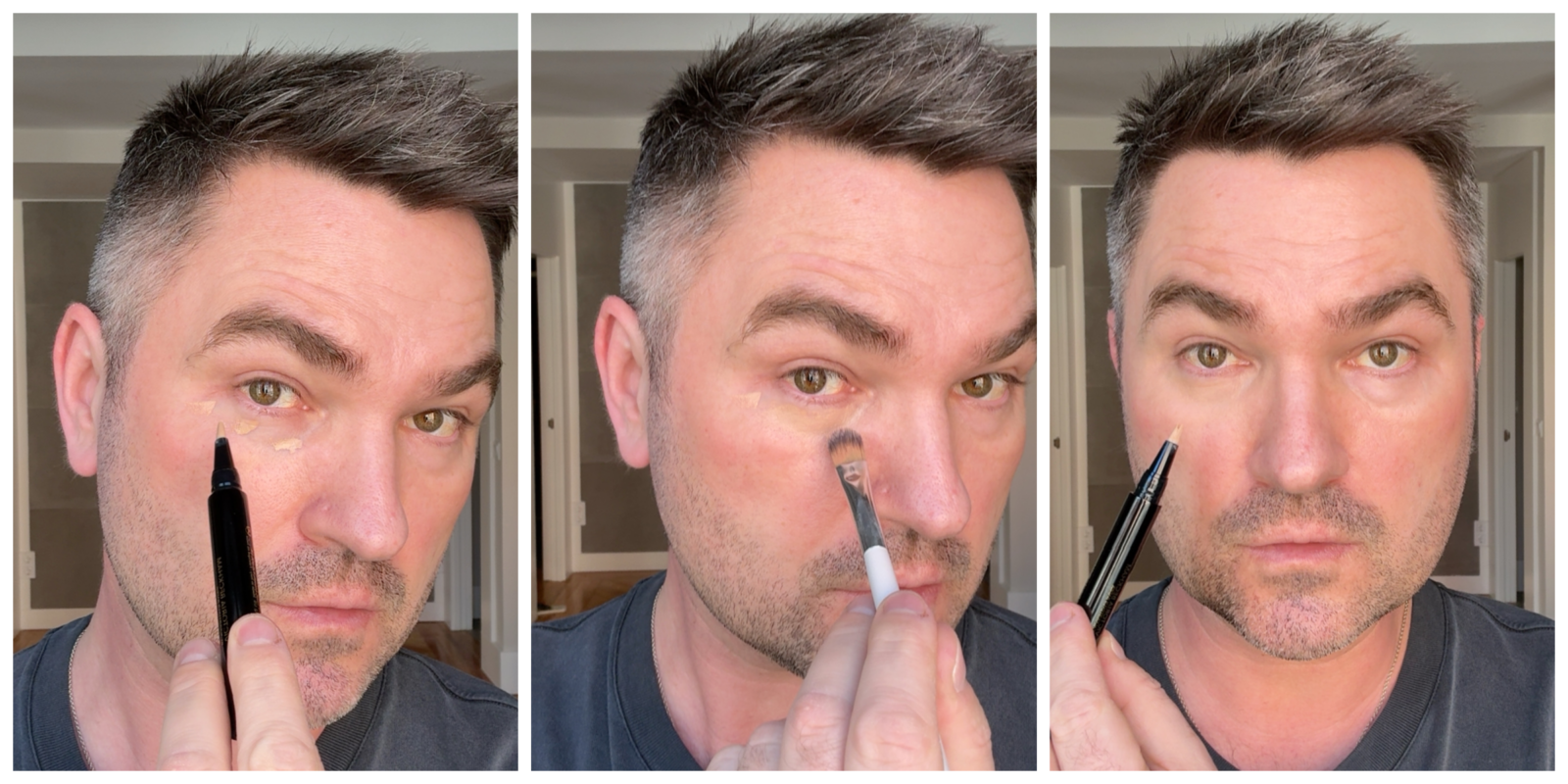
The Victoria Beckham x Augustinus Bader Concealer Pen is a slim, clickable pen with a brush tip. A few dots here and there, blended out, and you’re done. I am no stranger to this format. The click pen concealer is now ubiquitous for good reason. Ease of use is hard to beat. The one drawback is travel. Rattling around in a bag, unwanted clicks can overdispense product under the cap.
The shades
The pen comes in 19 shades and covers a wide range of skin tones. My issue is with the undertones. Choosing shades online was a challenge, and I usually know exactly what I want. This range runs warm. I went with L2 (Light 2) and LM2 (Light Medium 2). Two pens also helped me hit free shipping and maximize the discount.
There was another reason for buying two. A pro makeup artist friend told me the concealer works incredibly well as a full-face spot treatment in place of foundation, giving light, natural-looking coverage. That sealed it.
Texture, application and performance
The texture is the first thing you notice. Creamy, not heavy. It glides on and blends in easily. Stays put. Coverage is light to medium and buildable. The finish is natural, slightly dewy, and surprisingly skin-like. It color corrects subtle imperfections without announcing itself.
Most days, applying it with just my fingers does the job. For the most precise blending and best-looking finish, a brush is the way to go. I like this Jones Road Beauty one for under my eyes and this Anisa brush for all over face.
I do not prime or set the little makeup I wear. Yet, I expect it to perform anyway. Lazy, picky, or delusional — probably all three. The concealer holds up regardless.
Makeup but make it skincare
This is where I side-eye the marketing copy, at least a little. The VB x AB concealer is infused with Augustinus Bader’s proprietary TFC8 complex, the same technology behind The Rich Cream. The partnership is smart. A doctor-led, science-backed skincare brand and a makeup line built around quiet luxury — the synergy makes sense on paper.
But makeup is the last thing to go on the skin. Skincare actives need to be first-to-skin to perform at their best. Is this concealer anti-aging? No. Does it feel like a pigment-forward skincare product? Yes. You would not apply your peptide serum after sunscreen, either. That distinction matters.
Shade notes
If L2 had a touch more coolness to it, I would be obsessed. It works on my skin tone, but a hint of pink in the base would make it perfect. LM2, on the other hand, is excellent for correcting and concealing all over when I have some color. Living in Madrid, that is about nine months out of twelve.
Performance-wise, it lasts all day and does not crease. For light-to-medium coverage that leans closer to medium, that is impressive. The packaging looks the part too. Slim black pen, shiny blue cap detail. A classic Posh move for your makeup kit.
Worth it?
Close to excellent, but I am on the fence about repurchasing. Which also means: if the sale comes back, I probably will.
One thing worth flagging if you are shopping from Europe: the price gap is real. The pen is $68 in the US and €75 in the EU. After conversion, that €75 works out to roughly $85. The transatlantic workaround I used, ordering in USD with a US shipping address, saved me a meaningful amount (especially during the 20% off promo).
$68 (2.4ml) at victoriabeckhambeauty.com and violetgrey.com
This post contains affiliate links. If you click through and make a purchase, I may earn a small commission—at no cost to you. It helps keep my mist habit funded and this blog running. Thank you for reading.
Over the summer, a plastic surgeon hung old movie stills of Denise Richards on his operating room wall. There she was in Stormship Troopersblue-eyed with the kind of bold brows and piecey layers that defined the ’90s. In a way, she defined the ’90s. Richards was a sex symbol in a decade that absolutely idolized sex symbols, the star of Wild Things, a Bond girl, and also had cameos on almost every era-defining show—Seinfeld, Beverly Hills 90210, Saved by the Bell, Melrose Place, Married… with Children. But back to that OR. Fast-forward about 30 years to this past June, and Richards, at age 54, had decided to get a facelift.
“I wanted to put things back up, where they were before,” says Richards, who’s had about eight months now to reflect on her decision. It’s not the first time she has had plastic surgery—Richards had her breasts done at 19, and has had revision surgery for her implants since then. But, she says, it is the first time she’s had cosmetic surgery on her face. “I was terrified,” says Richards, well aware that the world has watched her age. “Being in the public eye since my 20s, people know what I look like—a facelift is not something that I could hide.”
Now Richards is opening up about her plastic surgery the way the rest of us talk about what we did Tuesday morning. She is matter-of-fact and unapologetic, discussing incisions, drains, and swelling. She’s sitting at home in front of scattered framed photographs, subtly made up with her long hair swept over one shoulder, and her daughter’s cat occasionally popping up into our Zoom. Richards is now best known for her roles on reality TV—she’s been on Real Housewives of Beverly Hills, and had her own shows, including Denise Richards and Her Wild Things. Talking to her post-facelift, though, it’s hard not to think of her in the aughts, when she was in the news for her marriage, pregnancies, and divorce from actor Charlie Sheen—because she just looks so much like her younger self.
“It is night and day,” Richards says of her reflection before and after the facelift. “It’s shocking, actually.” After she had the facelift, she adds, other celebrities “were more comfortable telling me about theirs, but I’m not gonna name names.” Still, she says, it can be good to know that “it’s not just serums and working out and lasers” that make people like her look younger.
Thank you for your interest in writing for SELF. We are always looking for new writers to work with and want to make the pitching process as clear and straightforward as possible. Before you pitch us, please take a few minutes to read the following recommendations and guidelines.
Jump to:
We look forward to hearing from (and hopefully working with) you!
About SELF
SELF is a service-driven health and wellness brand. Our goal is to help people take good care of themselves, their loved ones, and their communities. We pride ourselves on publishing trustworthy content that exemplifies our core brand values of inclusivity, accuracy, autonomy, and empathy.
To learn more about our brand, including our leadership team, editorial standards and practices, social channels, and newsletters, head over to our “About SELF” page here.
What to Pitch
Since SELF is a health and wellness brand, we’re looking for stories that explore personal, community, or public health, ideally with a service element. When pitching us a story, you should be able to answer the question: How is this helpful to the reader?
Before you pitch us, please search the site and our social channels to get a sense of our brand’s tone and philosophy (and also to make sure that you’re not pitching something we just covered). Our core verticals and areas of focus include: health (news, trends, health conditions, mental well-being, sexual and reproductive health, and sleep); fitness (workout trends, tips and explainers, gear, and women’s sports); food (nutrition trends, and tips); love (sex and relationships of all kinds, including platonic, familial, and romantic); and life (motherhood, money, career, and culture).
Here are some types of stories we’re looking for from freelancers right now:
Reported Service
We focus almost exclusively on service journalism—stories that give people the information they need in order to take action. We’re typically looking for reported pieces that rely on research and expert insights. Think how-tos, tips, advice, and explainers that people can act on. It’s not enough for a story to simply explain why something is the way it is; it should also help people understand what they can do with that information and how to apply it in their own lives in a practical sense. A good service story should tell a reader: Do this, and here’s why.
Researchers have reported the first successful use of a genetically engineered high-POA-producing strain of the heterotrophic microalga Prototheca moriformis, pointing to its potential as a production host rather than just a lab-scale system.
That distinction is relevant for an ingredient that has seen growing interest but limited scale.
The study, which was partially funded by Société des Produits Nestlé SA and California-based biotech company Checkerspot, builds on earlier work, including a review published in February that summarized existing evidence around POA’s potential roles in skin health and metabolic function. In the review, which received no external funding, researchers highlighted a mix of in vitro, animal and limited human data, pointing to possible benefits in skin barrier function, hydration and lipid metabolism.
Diving deep into the data
For POA suppliers, most material is sourced from sea buckthorn, with some contribution from fish-derived sources, and both can be difficult to standardize. “It’s a relatively unstandardized domestic crop, and it’s very affected by seasonal variations,” Casey Lippmeier, CTO of Checkerspot, told NutraIngredients in an exclusive first-look interview.
For manufacturers, that variability can show up quickly, whether in potency, formulation decisions or finished product claims.
The new study focuses instead on controlled production. As reported by researchers, the engineered P. moriformis strain reached more than 50% POA of total fatty acids during screening, compared to under 1% in the original strain. In shake-flask experiments, levels climbed to 58.2%.
When tested in a 1 L fed-batch fermentation, the system produced 47.8 g/L of lipids with POA accounting for 43.5% after 96 hours, or roughly 20.8 g/L. The authors note that the profile shifted somewhat at higher cell densities, but the overall POA enrichment remained.
They also point back to earlier work showing that P. moriformis can be run at much larger fermentation volumes, which is where the commercial argument starts to take shape.
In consideration of commercialization
From an industry standpoint, the appeal is fairly straightforward. Fermentation offers more control than agricultural or marine sourcing, both in terms of inputs and output consistency.
That feeds into cost as well. “We have a much more stable cost proposition for the long term,” Lippmeier said, pointing to reduced exposure to fisheries and other constrained raw materials.
For now, most commercial activity around POA remains in supplements and beauty-from-within, where the ingredient already has some traction. Evidence on skin hydration and barrier function is often cited, while metabolic benefits remain under exploration.
If supply becomes more predictable, though, the range of applications could widen. The study itself points to potential across nutrition, personal care and related categories, assuming further work on both process optimization and clinical validation.
At this stage, the science around POA is still evolving. The manufacturing side, however, may be starting to catch up.
I wrote this guide because we get a huge number of questions on this topic, and there is no definitive set of guidelines on the subject. There are a few good resources, but the information can be contradictory: one person says clary sage is no problem, another says avoid it at all costs. A practitioner with Traditional Chinese Medicine training avoids evergreen oils in pregnancy, while a traditionally trained aromatherapist uses them to increase energy and stamina. In addition, you probably have friends and coworkers who are promoting essential oils from multilevel marketing companies. In short, a pregnant person can end up pretty confused about the whether or not to avoid essential oils during pregnancy.
Are Essential Oils Safe During Pregnancy?
The short answer? Yes! As a western-trained physician and CEO of a natural skincare company, I’ve looked at the data, read the studies, and sought the opinions of expert aromatherapists. Below is my common sense guide to using essential oils in pregnancy that synthesizes all this great information while keeping a connection to evidence-based medicine. The chart below lists essential oils by category, to help you decide which oils, if any, you feel comfortable using. If you’re an aromatherapist, or working with one, you should feel free to explore the boundaries of this guide. But, if you just need some safe guidelines for using essential oils in pregnancy, here they are.
Why Avoid Synthetic Fragrance During Pregnancy?
Synthetic fragrance is one of the least transparent ingredients in personal care products. The single word “fragrance” or “parfum” can represent dozens—or even hundreds—of undisclosed chemicals, many of which are used to stabilize scent.
One of the most common categories of these chemicals is phthalateswhich are used to help fragrance last longer. Phthalates are known endocrine disruptors and have been associated with hormone disruption, reproductive effects, and developmental concerns.
Unlike essential oils, which are derived from plants, synthetic fragrance compounds are often petroleum-based and designed for consistency and longevity—not biological compatibility.
This is one of the reasons I recommend avoiding synthetic fragrance not just during pregnancy, but in general.
Are Essential Oils Safer Than Synthetic Fragrance?
When used properly, high-quality essential oils are generally a safer option than synthetic fragrance.
That does not mean they are risk-free. Essential oils are potent, biologically active compounds, and they require thoughtful use—especially during pregnancy. Some components can cross the placenta, and certain oils are not appropriate depending on timing, dose, and individual sensitivity.
However, professional aromatherapy organizations note that therapeutic-quality essential oils, used in low dilution, present relatively low risk compared to synthetic fragrance compounds.
In practical terms:
Synthetic fragrance = unknown mixture, often containing endocrine disruptors
Essential oils = known plant-derived compounds, used in controlled dilution
That’s why, in well-formulated skincare, a low concentration of appropriate essential oils is often a more transparent and biologically aligned choice than synthetic fragrance.
As always, pregnancy is a time to simplify. If your skin becomes reactive or your sense of smell shifts (which it often does), unscented products are the safest route.
How to Use Essential Oils Safely During Pregnancy
Internal essential oils should be avoided during pregnancy because taking essential oils by mouth results in the greatest exposure to the developing baby. If you plan to use essential oils orally, you must do so under the guidance of a trained expert. They are potent medicines, and even beautiful, fragrant plants can be toxic!
Using undiluted essential oils on the skin during pregnancy (and most other times) is not safe for many essential oils. Generally, I do not recommend undiluted topical application during pregnancy.
Other methods of essential oil use include baths, inhalation, wash-off products, and leave-on products. This will come down to personal choice, but the safest plan is one you’ve heard before: everything in moderation! Use appropriate essential oils (see chart) moderately and in low concentrations.
Keep in mind that your skin and your nose can be much more sensitive during pregnancyso less is more. It’s a time of many fluctuations, and skin issues during pregnancy are (unfortunately) not uncommon. Of note, phototoxicity is more common in pregnancy, so I’ve included a section in the chart about phototoxic oils.
If you find that your skin is super sensitive or reactive during pregnancy, stick to unscented products.
Lastly, and very importantly, remember that just because you used an essential oil in pregnancy does not mean it’s safe for your newborn baby! Babies have sensitive skin, developing systems, and immature immune function, so most essential oils are too potent for babies under one year of age. I recommend using unscented products on babies under one, and then incorporating appropriate oils in moderation, with the guidance of an accredited aromatherapist.
Diffusing Essential Oils During Pregnancy
Diffusing essential oils is one of the lowest-risk ways to use them during pregnancy because exposure is relatively minimal compared to topical or internal use.
That said, more is not better. Use a few drops at a time, keep the room well ventilated, and take breaks rather than diffusing continuously.
If a scent makes you feel nauseated, headachy, or off in any way, trust that signal and turn it off. Pregnancy is not the time to push through discomfort in the name of wellness.
Which Essential Oils Are Safe During Pregnancy?
This essential oils safety chart is based on several factors. First, I reviewed the scientific information available online, including guidelines from the International Federation of Professional Aromatherapists (IFPA) and the National Association for Holistic Aromatherapy (NAHA). Then, I reached out to several nationally known aromatherapists** and had them review this chart, incorporating most of their suggestions. If you want to dig deeper on the available data, check out Essential Oil Safety by Robert Tisserand.
FAQ: Essential Oils and Pregnancy
Can essential oils cause miscarriage?
There is no evidence that normal, diluted use of appropriate essential oils causes miscarriage. Problems arise with excessive use, internal use, or highly concentrated exposure.
Are essential oils safe in the first trimester?
Most caution comes from the first trimester, when fetal development is most sensitive. Using essential oils sparingly, in low dilution, and avoiding internal use is a reasonable approach.
Which essential oils should be avoided during pregnancy?
There is no universally agreed-upon list, which is part of the confusion. Some oils are more commonly cautioned against based on historical use or theoretical concerns. Reference the chart above to decide what feels right for you.
Is lavender oil safe during pregnancy?
Lavender is generally considered one of the gentler essential oils and is commonly used during pregnancy in low concentrations, though individual sensitivity always matters.
Can I use essential oils on my baby after birth?
No. Most essential oils are too potent for babies under one year of age. Stick to unscented products unless working with a trained professional.
Common Sense and Moderation
Above all, remember that most essential oils (except those in the first section of the table below) are safe in pregnancy when used in low dilutions, like a couple drops in a bath, a diffuser, or a massage oil. There are zero studies showing evidence of birth defects or miscarriages due to “normal use” of appropriate essential oils. Using large, undiluted quantities of any essential oils, either internally or on the skin, is a bad idea during pregnancy—and all other times!
If you have questions, please email us anytime at help@osmiaskincare.com—we’re here to help!
With love and wishes for a relaxed, healthy pregnancy,
The information contained in this post is for educational interest only. This information is not intended to be used for diagnosis or treatment of any physical or mental illness, disease, or skin conditions.
**Very special thanks to Robert Tisserand, Hope Gillerman, and Amy Galper for their expertise and guidance. Though I may not please them all with my compilation of their opinions, I am fairly certain nobody will gasp in horror, and I am very certain this article provides safe guidelines for expectant mothers.
References:
National Association for Holistic Aromatherapy (NAHA). Pregnancy Guidelines. Read Guidelines
National Association for Holistic Aromatherapy (NAHA). Safety in Aromatherapy. Explore Safety Information
Tisserand R, Young R. Essential Oil Safety: A Guide for Health Care Professionals2nd Edition.
“Dating apps aren’t inherently unsafe, but misleading AI-generated content is making it much harder to know who to trust: our research shows 84% of UK dating app users think AI content has made online dating less trustworthy,” reveals Mick Amelishko, AI Advocate at full-cycle verification platform Sumsub. “Despite that, over half of users are open to using AI to edit or generate profile content.”
“Powerful, readily-available AI image platforms make it easy for dating app fraudsters to pull off sophisticated, multi-level scams. Next-gen AI tools, like the one used to create the viral Stranger Things deepfakes, allow bad actors to generate highly convincing images, videos and audio to make fake profiles more believable and build rapport with victims.”
“Over a quarter of users say they struggle to identify deepfakes or AI-altered profiles. This makes your standard online safety starting points – like asking for voice notes or personalised videos – much less reassuring.”
How can you keep safe when dating online?
“Check profiles for consistency across images, personal details and behaviour over time,” shares Amelishko. “Moving to real-time interaction early, such as a video call, helps confirm that a person matches their profile.”
“Give potential scammers as little to work with as possible,” Amelishko continues. “Be mindful of the personal details you share with potential dates before you meet up in-person: personal, financial or sensitive details should not be disclosed to someone only known through an app.”
“This being said, users shouldn’t have to deal with deepfake scammers alone. Dating platform providers have a responsibility to verify user identities and prevent misleading content from circulating. This means moving verification and liveness checks beyond the signup stage, introducing dynamic verification based on suspicious behaviour, and taking the time to educate users on what AI is capable of and how to stay ahead of it.”
Should you specify if you’ve never dated the same-sex before?
“In my opinion, there is no fixed rule that says you have to disclose that you’ve never dated someone of the same gender,” explains Dr Lalitaa Suglani, eHarmony’s relationship expert. “However, it can be important to consider the dynamic, your values, the other person involved, and how they might feel.”
“For some people, that information may feel significant in terms of expectations, emotional readiness, or how they choose to engage. So, it tends to be less about obligation and more about mutual respect and transparency.”
“It might be useful to reflect on your intention for not wanting to share this, as it ultimately comes down to your values, your comfort, the kind of connection you want to build, and how safe you feel.”
“If it feels relevant, it will often come up naturally in conversation. Sharing it openly, without shame or over-explaining, can actually create more trust and ease on both sides as you get to know each other.”
Where can bisexual people meet other bisexuals offline?
“Everyone is coming offline lately,” shares Edward Reese, Community Manager, Gender and Sexuality Expert at Taimi. “I’d recommend checking for local queer events, speed-dating mingles, and community centers. We’re all for bi4bi – bisexual folks still face stigma and discrimination even in the LGBTQ+ community, and sometimes it’s easier to connect to those who understand the struggle.”
There are plenty of great queer events, whether those are for dating or friendship. If nothing else, you might have luck at a queer bar or club night!
How do you avoid the ‘male gaze’ when dating the same sex?
As a bisexual woman, it can be hard to unlearn the lessons of heterosexual dating. Even to start dressing for yourself rather than the patriarchy. So how can you enter bisexual dating without the anchors of the ‘male gaze’?
“Firstly, it’s not about assuming there won’t be dynamics like dominance or differing energies, because those can absolutely still exist in queer relationships,” explains Dr Suglani. “We need to be mindful that every connection is unique, as each person will have different needs.”
“The key difference is that the ‘male gaze’ is rooted in societal conditioning around performance, objectification, and external validation,” she continues. “So, the focus is less on trying to eliminate certain dynamics and more on becoming aware of whether you’re acting from authenticity or from learned patterns of needing to perform, please, or be seen in a certain way.”
“Even within dynamics where one person feels more dominant, there can still be mutual consent, presence, and genuine connection, rather than unconscious performance. It’s about staying connected and grounded in your own desires, boundaries, and truth within whatever dynamic naturally unfolds between two people.”
Any tips for dating as someone new to their bisexuality?
I’ve been there, and it can feel scary. Suddenly, you might know exactly how to navigate dating the opposite sex, but feel completely clueless when it comes to your own, more familiar gender. The truth is, everyone starts somewhere — whether that was at 13, 21, or 49.
The right person will never judge you for being new to your journey.
Treat it like you would any other dating experience: be open and honest about your concerns and insecurities, don’t rush anything physical if you’re not ready, and think about what you actually enjoy in dating… and in the bedroom. There are plenty of great tips online and across social media, and it helps to make some queer friends along the way, so you have people you can talk to openly about your experiences.
Many apps now let you filter for attraction to multiple genders, but are there actually features that reflect that in practice? Is the pool genuinely full of queer users, or does it still skew heavily towards straight men? And crucially, can you match with fellow bisexuals (arguably the hottest people on dating apps)?
Of course, it’s not just my opinion that counts. I’m writing from the perspective of a bisexual cis woman, but dating — and bisexuality — is far from one-size-fits-all. I wanted this to reflect the full spectrum of bi experiences, whether that’s dating sites for single parents, dating apps for over 40s, or somewhere in between.
That’s why I tapped in expert advice, user reviews, fellow Glamour editors’ experiences, and, of course, my IRL bisexual besties. And rest assured: if I wouldn’t recommend an app to a friend, it didn’t make the cut.
Well, to put it bluntly: I’m bisexual and an ecommerce writer specialising in dating, sex and relationships. I know, it doesn’t get much more on-brand than that.
I’ve been writing about the weird and wonderful world of love and lust for over four years now, and I’ve been dabbling in dating apps for even longer. At this point, I’ve seen it all: terrible first dates, sweet second dates, heartbreaking situationships, long-term relationships, and, of course, breakups. Oh, I know breakups.
In short, I know the best and the worst of the dating app world, and, crucially, where to find people of all genders as a bisexual who doesn’t want to limit themselves.
In a large warehouse, bales of plastic waste reveal logos that are quite familiar to French consumers — Tex-Mex ready meals, red and blue soda brands, snack wrappers, etc. Compacted into bundles weighing over 420 kilos by waste management specialist Paprec, the material is then delivered to the TotalEnergies site.
“Zero-oil platform”
Rather than being incinerated or landfilled — like roughly three-quarters of plastic waste in France — this by-product of consumer society is, the group says, destined for a more virtuous use: helping close the loop on plastic production by substituting for naphtha, its primary raw material.
Naphtha is largely a product of oil refining—the very activity that defined the vast Grandpuits gigantic facility for decades. Since 1967, the site produced gasoline and diesel for road transport, kerosene for aviation, fuel oil, as well as gas and naphtha. But in 2020, a leak in the pipeline supplying crude oil from Le Havre prompted the hydrocarbon giant to convert the huge industrial site into a “zero-oil platform.” Since then, some of the project’s initial ambitions have been scaled back, with several planned activities put on hold.
However, on Thursday, March 19, TotalEnergies announced the launch of what it describes as “France’s first advanced plastics recycling plant,” using a technology developed by the British firm Plastic Energy. Last August, the company said it had produced plastic pyrolysis oil — marketed under the brand name “Tacoil” — at its plant in Geleen, Netherlands, operated in partnership with the Saudi chemicals giant Sabic.
At the Grandpuits site, the first tanker truck of Tacoil — a dark, flammable oil — left in early March for Antwerp, Belgium, where TotalEnergies operates a refining and petrochemicals platform, according to site director Guillaume Alliot. This hydrocarbon can be used to produce recycled plastics “of the same quality as virgin plastics,” the group said in a press release. TotalEnergies sources its plastic waste from Paprec and the eco-organization Citeo.
The project’s scale remains limited. The facility can process up to 15,000 tonnes of waste a year — less than 0.3% of the 5.5 million tonnes of household packaging expected to be placed on the French market in 2024according to Citeo. At full capacity, it would generate roughly one truckload of pyrolysis oil per day — a drop in the ocean.
Challenging the “recycling myth”
The economic model for chemical plastic recycling “is still under construction,” and “it will take years before the activity reaches significant production volumes,” Jean-Yves Daclin, Managing Director for France at Plastics Europe — the industry association — told AFP in early February. The process is energy-intensive and costly, while demand for the resulting materials remains limited for the time being.
Beth Gardiner, author of Plastic Inc. — a book on an industry set to produce a record 430.9 million tonnes of virgin plastic worldwide in 2024 — notes that pyrolysis oil must be “blended with large amounts of virgin naphtha” from petroleum to create new plastic. “The industry is really trying to sell chemical recycling as a miracle solution” to the plastic waste crisis, she adds, “but the evidence simply isn’t there.”
The NGO Zero Waste also criticizes the process for perpetuating the “myth” of infinitely recyclable plastic, when in fact this material degrades throughout its lifespan.
Nonetheless, chemical recycling is one of the solutions authorities are exploring to reduce pollution from plastic packaging. In early February, the 27 member states of the European Union approved its inclusion in the mandatory recycled content requirements for plastic bottles.








.jpg "13 Best Bisexual Dating Apps, Approved By Experts 2026")