

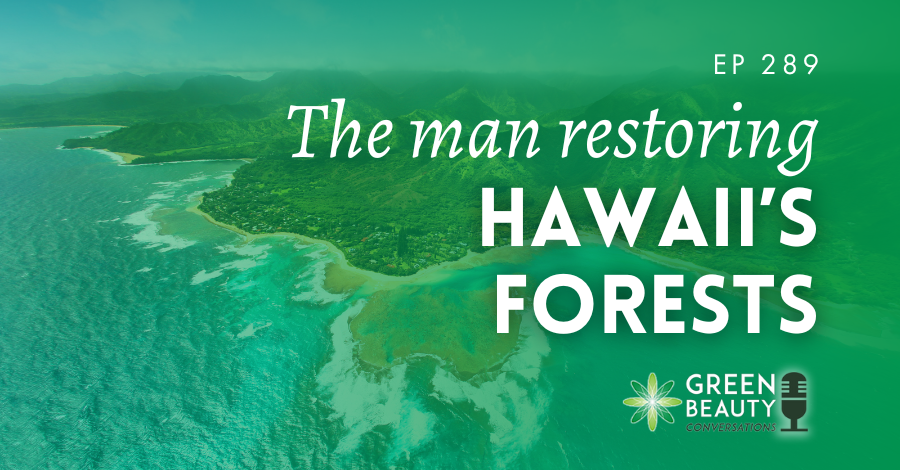
When we talk about natural beauty, we often imagine lush forests and pristine ingredients. But how often do we ask ourselves whether those forests are thriving or vanishing?
The truth is that the botanicals we celebrate in natural beauty are inseparable from the health of the ecosystems they grow in. When forests are degraded, we don’t just lose biodiversity – we risk losing rare, place-based ingredients that connect us deeply to nature.
In this episode of Green Beauty Conversations, Lorraine Dallmeier speaks with Asa Suguitan, co-founder of Hawaii Sandalwood, who is working to restore one of the rarest ecosystems in the world – Hawaii’s tropical dryland forest.
Asa’s family’s project is the only source of organic, eco-certified sandalwood products in the USA, and it’s built on a radical approach: harvesting only dead or dying trees while replanting 16 native Hawaiian species. The result is a model of sustainability that protects a unique species of sandalwood found only on Hawaii’s Big Island.
This is more than a conversation about cosmetic ingredients – it’s about rightthe Hawaiian principle of responsibility to the land. And Asa’s story shows how regenerative sourcing can fund reforestation, rebuild habitats and produce extraordinary ingredients for the beauty industry.
If you care about sustainability, you’ll want to hear how Hawaii Sandalwood is bringing forests – and hope – back to life.

“In Hawaii, we have a belief that if you take care of the land, the land will take care of you.” — Asa Suguitan
In this episode with Asa Suguitan, you will hear:
- The vision behind restoring Hawaii’s sandalwood forests: Asa explains how his uncle’s dream in 2009 to purchase degraded land sparked a reforestation project that has since transformed part of Hawaii’s rare tropical dryland forest.
- Why only dead or dying trees are harvested: Asa shares how this practice not only prevents further harm to the ecosystem but also encourages new sandalwood saplings to grow from existing root networks.
- The unique nature of Hawaiian sandalwood: Discover how Sandalwood paniculatefound only on Hawaii’s Big Island, differs chemically and historically from Indian and Australian sandalwood.
- How hydrosols and essential oils fund reforestation: Asa reveals the innovative ways Hawaii Sandalwood turns by-products such as fine sandalwood dust and hydrosols into valuable cosmetic ingredients that support forest restoration.
- Collaboration with global farms and forests: This episode also explores Asa’s role in Essential Botanical Farms & Forests, a network of like-minded growers worldwide who are creating a new model for regenerative ingredient supply.
Key takeouts include:
- Reforestation as a business model: Hawaii Sandalwood demonstrates that ecological restoration and ingredient production are not mutually exclusive. By using only dead sandalwood trees, the company ensures both regeneration and revenue, creating what Asa calls a virtuous cycle between forest health and ingredient quality.
- The ecological importance of sandalwood: As a semi-parasitic tree, sandalwood depends on surrounding species to thrive. This means that restoring sandalwood also requires rebuilding entire ecosystems, including 16 other native Hawaiian species. A healthy forest enables sandalwood to flourish without harming its host trees.
- Hydrosols as a powerful natural ingredient: Beyond essential oils, sandalwood hydrosol has antimicrobial and antibacterial properties. Tested against acne, dandruff, and staphylococcusit offers formulators a sustainable water replacement that carries functional skin and hair benefits.
- Global cooperation for regenerative ingredients: Through Essential Botanical Farms & Forests, Asa helps coordinate projects from Ecuador to North America and Japan. These farms grow ingredients within their native ecosystems, focusing on reforestation and habitat restoration rather than high-yield monocultures. Together, they offer traceable, story-rich ingredients to the beauty industry.
- Accessibility for indie brands: Unlike many bulk ingredient suppliers, Hawaii Sandalwood and its partner farms keep minimum order quantities low so that small beauty brands can access high-quality, regenerative ingredients without prohibitive costs.
Meet our guest: Asa Suguitain, co-founder of Hawaii Sandalwood LLC
A sa Suguitan is the co-founder of Hawaii Sandalwood LLC, a family-owned business dedicated to reforestation, education, and environmental responsibility.
Hawaii Sandalwood produces the only organic, eco-certified sandalwood products made in the USA, strictly harvesting only dead or dying trees and replanting 16 native Hawaiian species to ensure long-term viability.
In addition to his work in Hawaii, Asa is also a founding partner of Essential Botanical Farms & Forests, a global network of farms and forests committed to reforestation, habitat restoration, and regenerative agricultural practices.
Find out more about Asa and Hawaii Sandalwood:
Related episodes:
Thank you for joining us for this episode of the Formula Botanica Green Beauty Conversations podcast. If you enjoyed listening, please share, subscribe and review this episode on Apple Podcasts, Spotify or Youtube so that more people can enjoy the show. Don’t forget to follow and connect with us on Facebook and Instagram.
FREE TRAINING
Learn how to become an
Organic Skincare Formulator
Join over 100,000 other Formulators
FREE TRAINING
How to become an
Organic Skincare Entrepreneur
Join over 100,000 other Formulators
FREE TRAINING
How to become an
Organic Skincare Entrepreneur
Join over 100,000 other Formulators
Leave us a comment

Lorraine Dallmeier is a Biologist, Chartered Environmentalist and the CEO of Formula Botanica, the award-winning online organic cosmetic science school. Read more about Lorraine and the Formula Botanica Team.
